

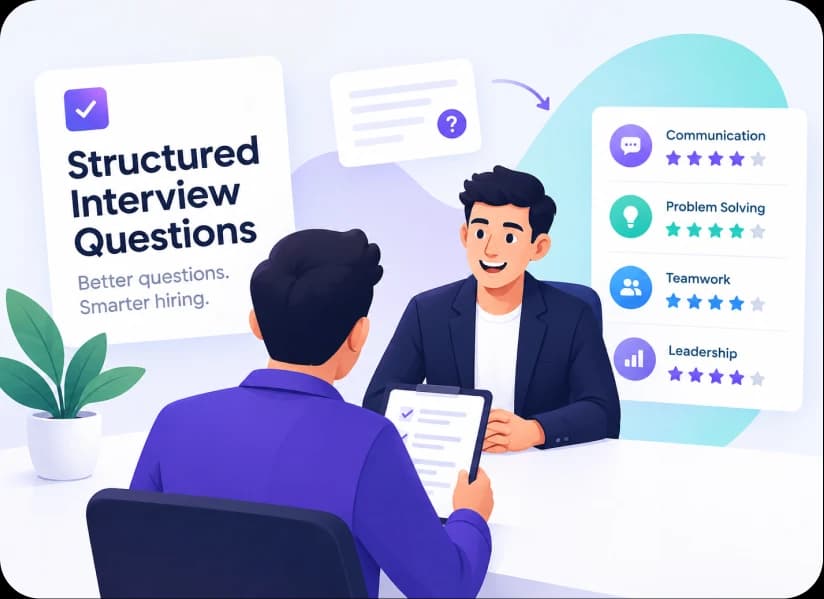
Schmidt and Hunter's landmark meta-analysis put the predictive validity of unstructured interviews at .38. Structured interviews reached .51, a gap large enough that Google rebuilt its entire hiring process around it.
Most hiring teams already believe in structured interviews. Fewer actually run them. The gap between believing in structure and building it usually comes down to two things: nobody has a ready set of questions organized by competency, and nobody has a scoring rubric simple enough for a busy interviewer to actually use.
This guide gives you both: real structured interview questions organized by what they actually test, a scoring template you can copy today, and the specific mistakes that quietly turn a structured interview back into an unstructured one.
Key Takeaways
Structured interviews ask every candidate the same core questions, in the same order, scored against the same rubric.
Structured interviews are meaningfully more predictive of job performance than unstructured ones. Schmidt and Hunter's landmark meta-analysis put the gap at .38 versus .51.
Google's internal research found structured interviews save about 40 minutes per interview while improving candidate satisfaction with the process.
Good structured interview questions are built around 4 to 6 core competencies for the role, not copied from a generic list.
A structured interview without a scoring rubric is only half-structured. The rubric is what makes results actually comparable across candidates.
The most common failure isn't skipping structure entirely. It's letting improvisation, delayed scoring, or reused questions quietly erode it.
What Is a Structured Interview?
A structured interview is a hiring method where every candidate answers the same predetermined questions, in the same order, and gets evaluated against the same scoring criteria. The interviewer follows a set script built around the role, rather than letting the conversation go wherever it happens to.
This is different from a semi-structured interview, which keeps a core set of planned questions but allows follow-ups to vary, and very different from an unstructured interview, which has no preset questions or scoring guide at all. Most interviews that feel informal or conversational are unstructured, even when the interviewer has good intentions and real expertise.
Why Structured Interviews Actually Work Better
Higher predictive validity: Schmidt and Hunter's meta-analysis found a validity gap of .38 versus .51 between unstructured and structured interviews. A more recent analysis by Sackett and colleagues in 2022 found a similar pattern, .19 versus .42, using updated methodology.
Real time savings: Google's internal research found that giving interviewers pre-built questions and rubrics saves an average of 40 minutes per interview.
Fairer comparisons: the same questions and criteria for every candidate make it possible to compare actual evidence, instead of comparing first impressions from different conversations.
More defensible decisions: consistent, job-related questions hold up better under scrutiny than a subjective read on someone, since every candidate was evaluated the same way.
Did You Know?
According to Google's re:Work guide on structured interviewing, giving interviewers pre-built questions and rubrics saves an average of 40 minutes per interview. Google's own hiring data also found structured interviews were consistently more predictive of on-the-job performance than unstructured conversations, across every function and level.
Structured vs. Unstructured Interviews
Structured
Unstructured
Questions
Same questions for every candidate.
Improvised in the moment.
Scoring
A shared rubric.
Subjective impression, no formal basis for comparison.
Comparability
Every candidate measured against the same bar.
Compares different conversations, not comparable evidence.
Time
Upfront work to build the set, faster afterward.
No prep, but longer to reach a confident decision.
How to Build Questions That Test What Matters
Good structured interview questions start with the role, not a generic list pulled from a search engine. Before writing a single question, identify the 4 to 6 core competencies the role genuinely requires, pulled from the job description, conversations with the hiring manager, and what strong performers in the role actually do day to day. Here's what that looks like in practice, organized by competency:
structuredInterviewArticle.buildingQuestions.subIntro
Problem-Solving
"Tell me about a time you identified a problem before it became urgent. What did you do, and how did you know it worked?"
A strong answer names a specific situation, the action taken, and a measurable outcome, not a general philosophy about problem-solving.
Collaboration
"Describe a project where you had to get buy-in from someone who didn't report to you. How did you approach it?"
Listen for how the candidate handled disagreement, not just whether they eventually got a yes.
Ownership and Accountability
"Tell me about a time something you were responsible for didn't go as planned. What did you do next?"
Weak answers deflect blame. Strong answers name what they personally did differently afterward.
Adaptability
"Walk me through a time your priorities changed with little notice. How did you handle it?"
This question tends to surface real behavior fast, since it's hard to fake a specific example under pressure.
Role-Specific Skill
Pick one competency unique to the role itself, technical depth for an engineer, negotiation for a sales role, objection handling for support, and build a question around a specific, realistic scenario the person would actually face on the job. Generic competencies get you generic signal. Role-specific ones don't.
A Simple Scoring Template
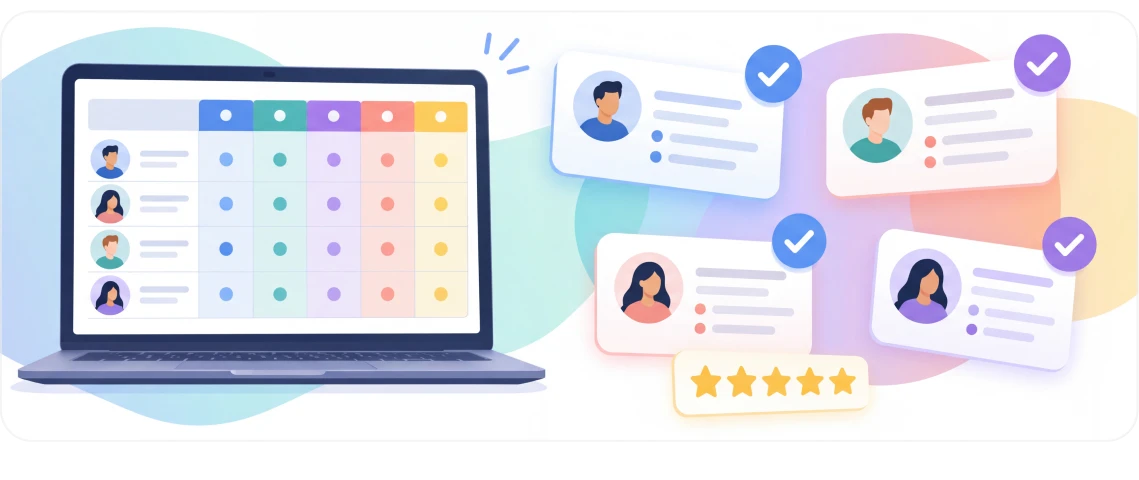
A structured interview without a rubric is only half-built. Here's a scoring approach simple enough that a busy interviewer will actually use it consistently:
1
Response doesn't demonstrate the competency, or the candidate can't provide a specific example.
2
Partial evidence of the competency, but the example is weak, generic, or missing key detail.
3
Clear, specific evidence the candidate has this competency, a real example with a real outcome.
4
Strong evidence, with the competency demonstrated in a complex or high-stakes situation.
Score each competency separately, right after the interview, not from memory the next day. Waiting to score is one of the fastest ways to lose the specifics that made the rubric useful in the first place.
Mistakes That Quietly Undermine Structure
Skipping the rubric: asking the same questions without a scoring guide still leaves you debating impressions in the debrief.
Letting one follow-up become a ten-minute tangent: a little improvisation is fine, but the interview stops being structured the moment it stops being comparable.
Scoring from memory: rate immediately after the interview, not at the end of the day, once every candidate starts to blur together.
Reusing one question set for every role: the competencies that matter for a sales manager aren't the competencies that matter for an engineer.
Skipping interviewer training: handing someone a question list with no context on what a strong answer looks like just produces inconsistent scoring dressed up as structure.
Where AI Fits Into a Structured Process
Structured interviews work, but running them consistently at scale is its own challenge. Every interviewer needs the same training, the same discipline about sticking to the rubric, and the same follow-through on scoring immediately after each interview. That's hard to guarantee across a growing team, and close to impossible across dozens of interviews a week.
Structured AI interviews solve the consistency problem directly. An AI recruiter asks the same core questions to every candidate, in the same order, and scores every response against the same rubric, every time, whether it's interview 3 or interview 300. Getgeek's AI recruiter runs interviews this way by default, in 20+ languages, so the structure doesn't depend on whether a particular interviewer remembers to follow the script.
For teams comparing AI-led interview platforms, it's worth checking how structured the underlying approach actually is. See how Getgeek vs HireVue compares on exactly this point, since not every platform scores interviews the same rigorous way.
Schedule structured interviews with the best AI recruiting platform
Writing good structured interview questions is the easy part. Running them consistently, every interviewer, every candidate, every time, is where most processes quietly fall apart. Getgeek runs structured interviews by default, so consistency isn't something your team has to enforce manually.
Book a DemoFrequently Asked Questions
What is a structured interview?
A structured interview is a hiring method where every candidate answers the same predetermined questions, in the same order, and is evaluated against the same scoring criteria.
What's the difference between structured and unstructured interviews?
Are structured interviews actually more effective than unstructured ones?
How many questions should a structured interview have?
What should a structured interview scoring rubric include?
Can structured interviews be run by AI?
Do structured interviews take longer to run than unstructured ones?
On This Page
- What is a structured interview?
- Why they work better
- Structured vs. unstructured
- Building the questions
- A simple scoring template
- Mistakes to avoid
- Where AI fits
- FAQ
Run the same structured interview for every candidate, automatically.
Book a DemoOn This Page
- What is a structured interview?
- Why they work better
- Structured vs. unstructured
- Building the questions
- A simple scoring template
- Mistakes to avoid
- Where AI fits
- FAQ
Run the same structured interview for every candidate, automatically.
Book a DemoGet weekly AI recruitment insights in your inbox
Join 5,000+ forward-thinking recruiters who rely on our analysis of AI recruiting trends, case studies, and strategies for the evolving talent market.
Ready to implement AI recruitment in your organisation?
As Johann Wolfgang von Goethe said: "Knowing is not enough; we must apply. Willing is not enough; we must do."
Don't just gather knowledge about AI in recruiting automation. Start the execution and experience the transformation yourself. See how Getgeek can revolutionise your hiring with a personalised demo.
See AI Recruitment in Action
Automate your company's hiring pipeline and deploy custom end-to-end AI solutions that deliver proven candidate matching.
Help
Platforms
Getgeek Job BoardSubscribe to newsletter
Call Us
(+92) 323-0295713
Email Us
contact@getgeek.ai