

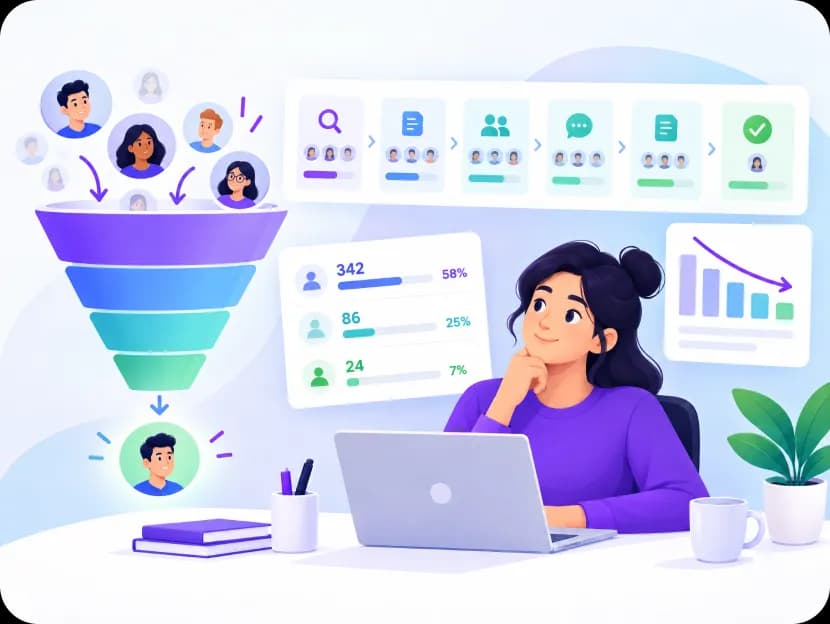
Most hiring teams already sense their funnel is losing people. What they usually get wrong is where. They blame the top, not enough good applicants, when the real leak is almost always in the middle: screening and interviewing, not sourcing.
That misdiagnosis is expensive. Teams respond by buying more job board credits or running more ads, which widens the top of a funnel that's already leaking in the middle. The applicant count goes up. The hire count doesn't move.
This guide maps every stage of the recruitment funnel, the metrics that actually show where candidates disappear, and what to fix first, starting with the stage most teams never think to check.
Key Takeaways
A recruitment funnel maps every stage a candidate moves through, from first seeing a job post to accepting an offer.
Most funnels lose the majority of candidates between application and interview, not between interview and offer.
Only about 3% of applicants typically reach the interview stage, and fewer than 1% receive an offer.
Tracking conversion rate at each stage, not just total applicants, is what actually reveals where a funnel is leaking.
Recruitment funnel, hiring funnel, and recruitment pipeline are largely interchangeable terms in everyday use.
Structured interviews and consistent screening criteria are among the most effective fixes for a leaky mid-funnel.
What Is a Recruitment Funnel?
A recruitment funnel is a model of every stage a candidate moves through during hiring, from first learning about a role to accepting an offer. Like a sales funnel, it's wide at the top, where many people enter, and narrow at the bottom, where only one person is hired.
The term recruitment funnel is often used interchangeably with hiring funnel, and closely related to recruitment pipeline, though pipeline sometimes refers more specifically to the candidates currently active in a given stage, rather than the overall model.
The Stages of a Recruitment Funnel
Most recruitment funnels follow the same basic shape, though some organizations add extra stages like phone screens or assessments depending on the role.
Awareness and sourcing
This is the top of the funnel, where candidates first learn a role exists. It includes job board postings, social media, employee referrals, and active outbound sourcing. The wider and more targeted this stage is, the more relevant applicant volume enters the funnel below it.
Application
Candidates who are interested submit a formal application. This is a drop-off point many hiring teams never measure: qualified candidates commonly abandon an application if the process is too long or unclear.
Screening
Applications are reviewed against the role's core requirements, either manually, through keyword filters in an applicant tracking system, or through automated candidate screening that evaluates every applicant against the same criteria. This is typically the stage with the steepest drop-off in the entire funnel.
Interview
Candidates who pass screening move to one or more rounds of interviews. This is where structured, consistent evaluation matters most, since inconsistent interview criteria are a common reason strong candidates get rejected for reasons unrelated to the role.
Offer
A candidate is selected and extended a formal offer. Offer acceptance rates vary by industry and role, but a sudden drop usually signals a mismatch between compensation, timeline, or expectations set earlier in the funnel.
Hire
The candidate accepts, and the role is filled. This is the bottom of the funnel, and historically the only stage most teams measured, which is exactly why full-funnel visibility matters so much.

Recruitment Funnel Metrics to Track
Total applicant count tells you almost nothing on its own. These recruitment funnel metrics show you where the funnel is actually leaking:
Stage conversion rate: the percentage of candidates who move from one stage to the next. Industry benchmarks generally run 12 to 20% for application-to-screen, 30 to 50% for screen-to-interview, and 15 to 25% for interview-to-offer.
Time-to-hire: the number of days from application to accepted offer.
Cost-per-hire: total recruiting spend divided by number of hires.
Offer acceptance rate: the percentage of extended offers that get accepted.
Source quality: which channels, referrals, job boards, direct sourcing, produce the candidates who actually get hired, not just the most applicants.
Drop-off rate by stage: the inverse of conversion rate, showing exactly where candidates are lost.
Where Candidates Actually Drop Off (and Why)
Most hiring teams assume they're losing candidates at the offer stage, since that's the most visible and painful moment to lose someone. In practice, the biggest losses usually happen much earlier, specifically between application and screening, and between screening and interview.
A few common causes:
Applications go unreviewed for days while resumes pile up in an inbox or ATS queue
Screening criteria are inconsistent between reviewers, so similar candidates get different outcomes
Interview scheduling takes so long that candidates accept another offer before a first conversation happens
Interview questions vary from one panelist to the next, making it hard to compare candidates fairly
None of these are top-of-funnel problems. They're process problems in the middle of the funnel, which is exactly where most funnels quietly break.
DID YOU KNOW?
Only about 3% of applicants typically reach the interview stage, and fewer than 1% receive a job offer, according to CareerPlug's 2025 Recruiting Metrics Report, which analyzed more than 10 million job applications. For every 180 people who apply to a role, roughly one gets hired.
How to Fix a Leaky Recruitment Funnel
Once you know where your funnel is losing people, the fixes are usually structural, not about attracting more applicants.
Screen every applicant consistently, not just the first batch
Manual review naturally slows down and gets less consistent as a queue grows. Automated candidate screening applies the same criteria to every applicant, whether it's candidate 5 or candidate 500, which matters most for high volume hiring roles where application spikes are common.
Standardize interview questions across every panelist
Structured AI interviews score every candidate against the same rubric, removing the variation that comes from different interviewers asking different questions. This is one of the highest-leverage fixes for the middle of the funnel, where inconsistent evaluation causes the most unnecessary drop-off.
Reduce the time between stages, not just total time-to-hire
A fast overall process with one slow stage in the middle still loses candidates. Look at the time between each individual stage, not just first-application-to-offer.
Use one system for the whole funnel, not five disconnected tools
Funnel visibility breaks down when sourcing, screening, and interviewing live in separate systems that don't share data. Platforms built as AI recruiting software from the ground up keep every stage, and every drop-off, visible in one place.
Revisit your funnel as your company grows
A funnel that works for a 50-person company hiring five a year often breaks at enterprise scale, when the same funnel has to support dozens of roles and multiple hiring teams at once. Enterprise recruitment software is built specifically to keep funnel visibility intact at that scale.
Recruitment Funnel vs. Recruitment Pipeline
The terms are often used interchangeably, and in most everyday conversation, that's fine. Where a distinction exists, recruitment funnel usually refers to the overall model, from sourcing to hire, including candidates who dropped out along the way. Recruitment pipeline more often refers to the candidates who are currently active in the process at any given stage.
In practice, most hiring teams use whichever term their tools or leadership already use, and both describe the same underlying idea: a structured path from candidate awareness to hire.
Where to go from here
A recruitment funnel only tells you what's happening if you're actually measuring it stage by stage. Getgeek automates screening and runs structured AI interviews across every candidate in the funnel, so the middle of your process stops being the place where good candidates quietly disappear.
Book a DemoFrequently Asked Questions
What is a recruitment funnel?
A recruitment funnel is a model of every stage a candidate moves through during hiring, from first learning about a role to accepting an offer. It's typically visualized as wide at the top, where many candidates enter, and narrow at the bottom, where only one person is hired.
What are the main stages of a recruitment funnel?
What's a good recruitment funnel conversion rate?
Where do most candidates drop out of a recruitment funnel?
What's the difference between a recruitment funnel and a recruitment pipeline?
How can AI improve a recruitment funnel?
How is recruitment funnel conversion rate calculated?
On This Page
- What is a recruitment funnel?
- The stages
- Metrics to track
- Where candidates drop off
- Fixing a leaky funnel
- Funnel vs. pipeline
- FAQ
Stop losing good candidates in the middle of your funnel.
Book a DemoOn This Page
- What is a recruitment funnel?
- The stages
- Metrics to track
- Where candidates drop off
- Fixing a leaky funnel
- Funnel vs. pipeline
- FAQ
Stop losing good candidates in the middle of your funnel.
Book a DemoGet weekly AI recruitment insights in your inbox
Join 5,000+ forward-thinking recruiters who rely on our analysis of AI recruiting trends, case studies, and strategies for the evolving talent market.
Ready to implement AI recruitment in your organisation?
As Johann Wolfgang von Goethe said: "Knowing is not enough; we must apply. Willing is not enough; we must do."
Don't just gather knowledge about AI in recruiting automation. Start the execution and experience the transformation yourself. See how Getgeek can revolutionise your hiring with a personalised demo.
See AI Recruitment in Action
Automate your company's hiring pipeline and deploy custom end-to-end AI solutions that deliver proven candidate matching.
Help
Platforms
Getgeek Job BoardSubscribe to newsletter
Call Us
(+92) 323-0295713
Email Us
contact@getgeek.ai