

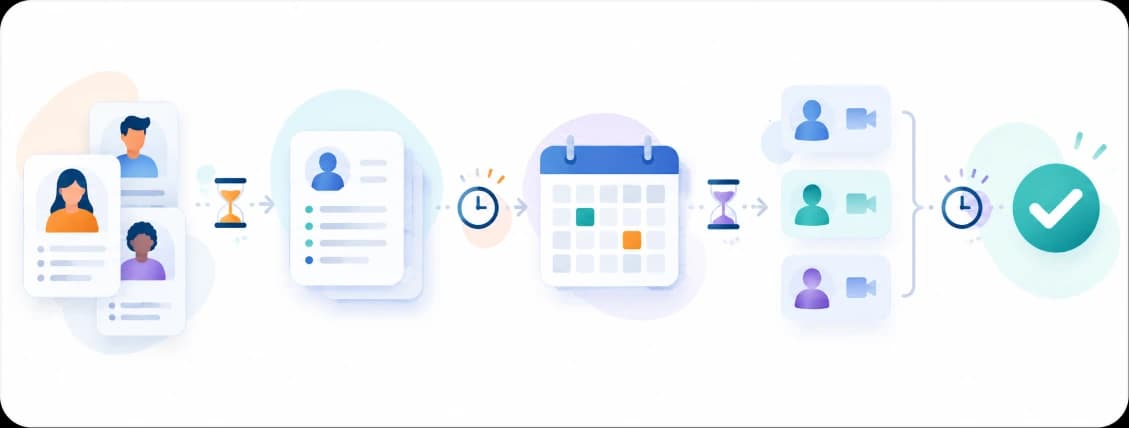
The average hiring process takes over six weeks from job posting to signed offer. Almost none of that time goes toward actually deciding who to hire. It goes toward waiting: waiting on an approval, waiting for a recruiter to find an hour to screen resumes, waiting for five calendars to line up for one interview.
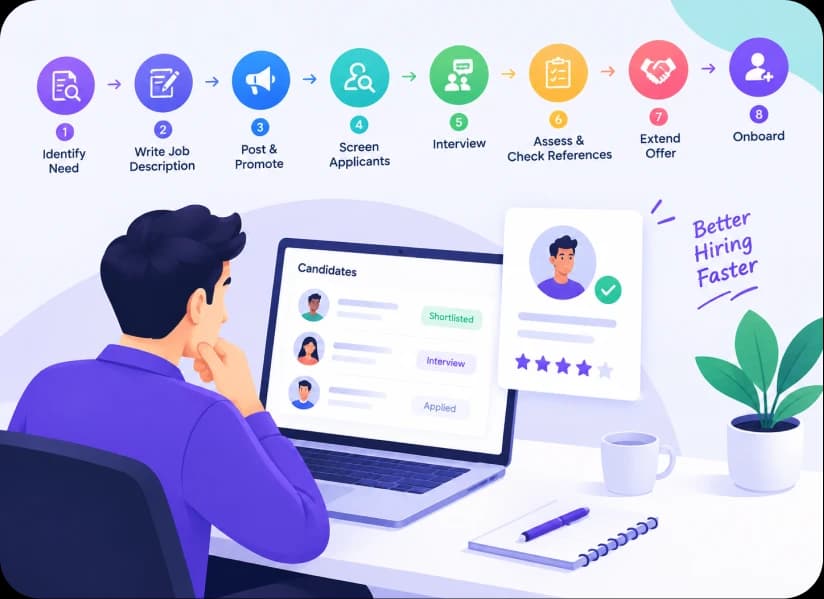
Ask most hiring teams to describe their process, and you'll get a short answer: post the job, review applications, interview, make an offer. In reality, a complete hiring process runs eight distinct steps, and the time nobody accounts for usually hides in the ones people don't think to mention, like getting a requisition approved or coordinating a second-round panel.
This guide walks through every step of a modern hiring process, what actually happens at each one, where time typically disappears, and what a faster version of the same process looks like.
Key Takeaways
A complete hiring process has eight steps, from identifying the need through onboarding, not just posting and interviewing.
Most lost time happens between steps, not during them: approvals, scheduling, and follow-up eat more time than the actual decisions do.
Screening is consistently the biggest bottleneck since manual review slows down and gets less consistent as applicant volume grows.
Hiring process, recruitment, and talent acquisition get used interchangeably, but they describe different scopes of work.
74% of recruiters say AI already makes hiring more efficient, most often in screening and scheduling, according to LinkedIn's Future of Recruiting 2025 report.
Onboarding is part of the hiring process, not a separate step after it. A strong hire with a weak first few weeks is a retention problem waiting to happen.
What Is a Hiring Process?
A hiring process is the complete sequence of steps a company follows to fill an open role, starting with recognizing the need to hire and ending with a new employee settling into the job. It covers more than sourcing and interviewing. A real hiring process also includes the internal work candidates never see: getting budget approval for the role, writing and rewriting the job description, and coordinating everyone who needs to weigh in before an offer goes out.
The terms hiring process, recruitment process, and recruitment life cycle get used interchangeably, and most of the time that's harmless. Where a real distinction exists, hiring process usually refers to filling one specific role, while recruitment life cycle describes the broader, ongoing cycle of workforce planning, employer branding, and pipeline building a company runs continuously, not just when a role opens.
The 8 Steps of the Hiring Process
Some companies compress this into six steps, others stretch it into twelve. Here's the version that covers what actually needs to happen, regardless of how a company labels it.
Identify the hiring need
Before a job goes anywhere, someone has to justify that it exists. This step covers the internal case for the role: budget, reporting line, and whether it's a backfill or a brand-new position. Skip it, and you're the team rewriting a job description three times after it's already posted.
Write the job description
A job description has to do two jobs at once: attract the right candidates and discourage the wrong ones before anyone applies. A vague description pulls in high volume and low relevance, and all of that extra weight lands on the next step.
Post and promote the role
The job goes live, on the careers page, job boards, and anywhere else it needs visibility. For roles that won't fill from inbound applications alone, especially specialized or senior ones, this is also where active sourcing starts.
Screen applicants
Every application gets checked against the role's core requirements. This is consistently where the most time gets lost, since manual review slows down and gets less consistent the moment volume picks up.
Interview
Candidates who pass screening move into one or more rounds. Structured interviews, where every candidate answers the same core questions against the same criteria, are one of the more well-documented ways to improve hiring outcomes, compared to letting each interviewer freestyle their own questions.
Assess and check references
Depending on the role, this might mean a skills assessment, a work sample, or reference and background checks. It's the last checkpoint before an offer goes out, and usually where a mismatch between resume and reality shows up, if there is one.
Extend the offer
A candidate is chosen and a formal offer goes out. Speed matters here more than almost anywhere else in the process. A slow offer is one of the easiest ways to lose a good candidate to whichever company moves faster.
Onboard the new hire
The process isn't finished when someone signs. Onboarding, documentation, equipment, a clear first-week plan, determines whether that hire actually sticks around. A strong hire paired with weak onboarding is a resignation waiting to happen.
Where Time Actually Gets Lost
Total timelines vary a lot by role and industry, but a few patterns hold up consistently:
Screening is the biggest single bottleneck. It's the step where manual review scales worst, since reviewing applicant 300 takes just as long as reviewing applicant 3, and there are far more of the former.
Structure beats improvisation in interviews. A consistent set of questions and scoring criteria, applied the same way to every candidate, is one of the more reliable ways to improve hiring outcomes across a team of interviewers.
Offer speed is almost entirely within your control. Once a decision is made, the time between deciding and getting an offer in front of the candidate is one of the few gaps a company can close immediately, without needing a bigger team.
AI-assisted hiring is now the norm. Most recruiters say AI already makes part of their process faster, and it's concentrated almost entirely in the two steps everyone already knows are the slowest.
Did You Know?
According to LinkedIn's Future of Recruiting 2025 report, based on a survey of more than 1,000 talent professionals, 74% of recruiters say AI already makes their hiring process more efficient, most commonly in screening and interview scheduling, the same two steps hiring teams most often name as their biggest bottleneck.
Hiring Process vs. Recruitment vs. Talent Acquisition
These three terms get thrown around as if they mean the same thing, and in casual conversation, they basically do. But they describe different scopes of work.
Hiring process: the specific steps a company follows to fill one open role, start to finish.
Recruitment: the same kind of work described at a broader level, the ongoing function of finding and hiring people, rather than a single role in isolation.
Talent acquisition: the widest of the three. It includes hiring, but also covers employer branding, workforce planning, and building a candidate pipeline before a role ever opens.
In practice, most people default to whatever term their team or their tools already use, and the overlap rarely causes real confusion. The distinction matters most when a company is deciding whether it needs a better hiring process, or a fundamentally different recruiting strategy.
How to Shorten Your Hiring Process Without Cutting Corners
Once you know where the time actually goes, most fixes are structural rather than about working harder.
Automate the step that eats the most time
Screening is almost always the single biggest bottleneck in a hiring process, and it's also the easiest to fix without losing quality. Automated candidate screening applies the same evaluation to every applicant, whether it's candidate 3 or candidate 300.
Standardize interviews before you try to scale hiring
A hiring process that depends on every interviewer improvising their own questions doesn't hold up past a handful of roles. AI interviews built around a consistent, role-specific script fix that at any volume, without adding headcount to your recruiting team.
Set a response-time standard and actually hold to it
Candidates don't wait around indefinitely. A clear internal standard for how quickly applications get reviewed does more to keep good candidates in the process than almost any other single change.
Treat high-volume roles differently from the start
A process built for the occasional, one-off role tends to break down fast under real high volume hiring: seasonal spikes, new store openings, bulk contracts. Those roles need a process built to scale, not a busier version of the same one.
Use one system, not five
A hiring process is only as visible as the tools running it. When sourcing, screening, and interviewing live in separate systems, nobody has a clear view of where a candidate actually stands. Platforms built as AI recruiting software from the ground up solve this by keeping the entire process in one place, not stitched together after the fact.
Where to go from here
A hiring process moves only as fast as its slowest step, and for most teams, that step is screening. Getgeek automates screening and runs structured AI interviews across every applicant, so the step that usually takes the longest stops being the reason a good candidate slips away.
Book a DemoFrequently Asked Questions
What are the main steps in a hiring process?
Most hiring processes include eight steps: identifying the need, writing the job description, posting and promoting the role, screening applicants, interviewing, assessing and checking references, extending the offer, and onboarding the new hire.
How long does the average hiring process take?
What's the difference between a hiring process and a recruitment process?
Which step in the hiring process usually takes the longest?
What makes a hiring process faster without lowering quality?
Does onboarding count as part of the hiring process?
Can AI be used at every step of the hiring process?
On This Page
- What is a hiring process?
- The 8 steps
- Where time gets lost
- Hiring vs. recruitment vs. TA
- Shortening the process
- FAQ
Automate the slowest step in your hiring process: screening.
Book a DemoOn This Page
- What is a hiring process?
- The 8 steps
- Where time gets lost
- Hiring vs. recruitment vs. TA
- Shortening the process
- FAQ
Automate the slowest step in your hiring process: screening.
Book a DemoGet weekly AI recruitment insights in your inbox
Join 5,000+ forward-thinking recruiters who rely on our analysis of AI recruiting trends, case studies, and strategies for the evolving talent market.
Ready to implement AI recruitment in your organisation?
As Johann Wolfgang von Goethe said: "Knowing is not enough; we must apply. Willing is not enough; we must do."
Don't just gather knowledge about AI in recruiting automation. Start the execution and experience the transformation yourself. See how Getgeek can revolutionise your hiring with a personalised demo.
See AI Recruitment in Action
Automate your company's hiring pipeline and deploy custom end-to-end AI solutions that deliver proven candidate matching.
Help
Platforms
Getgeek Job BoardSubscribe to newsletter
Call Us
(+92) 323-0295713
Email Us
contact@getgeek.ai