

Not because anyone's lying. Because most teams only count the costs that show up on an invoice: the job board fee, the agency fee, maybe the background check. The hours a hiring manager spends sitting in five rounds of interviews never make it into the math, even though that time costs real money too.
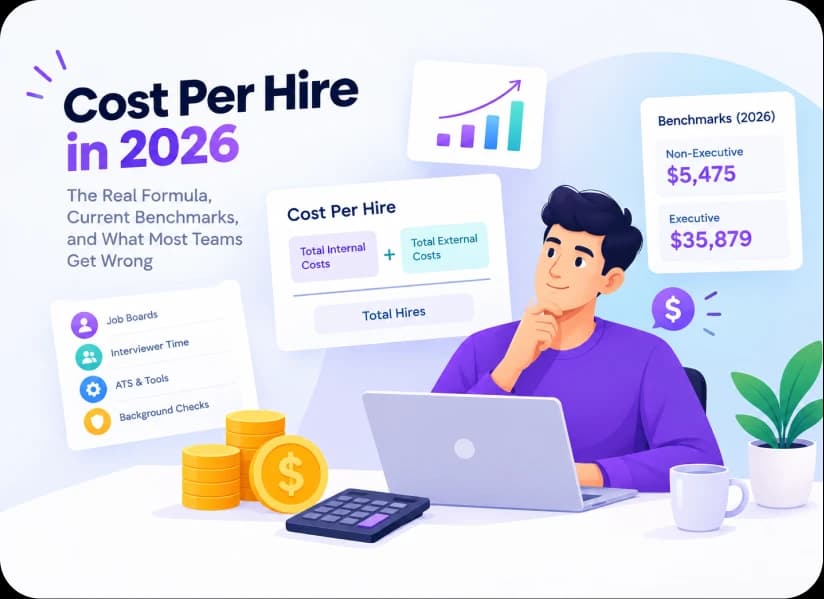
SHRM's most recent benchmarking puts the average cost per hire at $5,475 for non-executive roles, a sharp jump from figures that are still widely cited as current. But the published average matters less than knowing your own number, calculated the right way, and knowing which part of your process is actually driving it up.
This guide covers the standard formula, current benchmarks by role and company size, the costs almost everyone forgets to count, and where the biggest, most fixable chunk of that number usually hides.
Key Takeaways
Cost per hire follows a standard SHRM/ANSI formula: total internal and external recruiting costs, divided by total hires in a period.
SHRM's most recent benchmarking puts the average at $5,475 for non-executive roles and $35,879 for executive roles.
Most teams undercount their real cost per hire by leaving out internal costs like interviewer and hiring manager time.
Cost per hire varies significantly by company size. Smaller companies often pay more per hire than large ones with dedicated recruiting teams.
Screening and interview coordination are usually the biggest hidden internal cost, not job board spend or agency fees.
A high cost per hire and a slow time-to-hire usually share the same root cause: manual, inconsistent steps in the middle of the process.
What Is Cost Per Hire?
Cost per hire is the total amount a company spends, internally and externally, to fill one open role. It's one of the most widely tracked recruiting metrics because it's the clearest single number for whether a hiring process is efficient or expensive, and it's straightforward to calculate once you know what actually belongs in the formula.
The standard is set jointly by SHRM and the American National Standards Institute (ANSI), formalized in 2012:
Cost Per Hire = (Total Internal Recruiting Costs + Total External Recruiting Costs) ÷ Total Number of Hires
Simple as a formula. The hard part, and where most companies get their number wrong, is knowing what actually belongs in “total internal” and “total external” costs.
What Actually Counts as a Recruiting Cost
External costs
Job board and social posting fees
Recruitment agency or contingency search fees (typically 15 to 25% of first-year salary)
Background checks and pre-employment assessments
Candidate travel and relocation, where applicable
Signing bonuses and employee referral payouts
Recruitment marketing spend tied directly to hiring
Internal costs (the ones teams usually miss)
Recruiter and sourcer salary, allocated to time spent hiring
Hiring manager and interview panel time, valued at their actual hourly cost
HR administrative time
ATS and recruiting software, prorated across hires in the period
Onboarding coordination time, up to the point a new hire is fully set up
Teams that only count the external list report a cost per hire that looks great and means almost nothing. The moment hiring manager and interviewer time gets added in, the real number is often noticeably higher, sometimes by 30% or more.
A Real Cost Per Hire Calculation, Worked Out
Here's what the math actually looks like for a mid-size company. Say a 150-person company made 20 hires in a quarter.
INTERNAL COSTS
Recruiter time (allocated)
$32,000
Hiring manager & interviewer time
$18,000
HR admin time
$5,000
ATS and software (prorated)
$3,500
Total
$58,500
EXTERNAL COSTS
Job board and social postings
$6,000
Agency fees (2 roles)
$14,000
Background checks & assessments
$2,500
Referral bonuses
$4,000
Total
$26,500
Total recruiting spend $85,000 ÷ 20 hires = $4,250 cost per hire
Notice that internal costs, mostly recruiter and interviewer time, made up more than two-thirds of the total. That's typical. Most companies could look only at the external costs on this list and feel reasonably efficient, while the real spend is happening in the time their own team puts into the process.

Cost Per Hire Benchmarks in 2026
Published averages vary more than you'd expect, largely because different reports measure different years, different role mixes, and don't always include the same cost categories. The most specific, recently dated figure comes from SHRM's 2025 Benchmarking Report: $5,475 for non-executive roles, and $35,879 for executive roles, a jump of about 21% from 2022. Older figures closer to $4,700 still circulate widely and get cited as current, so it's worth checking the year and source behind any cost per hire number you see quoted, including this one.
Smaller companies (under 50 employees) often see the highest cost per hire, frequently $7,000 or more, since fewer hires means fixed costs like software and agency relationships get spread across a smaller base.
Mid-size companies (250 to 1,000 employees) typically land closer to $3,000 to $4,500, benefiting from more consistent hiring volume and repeatable process.
Large companies (1,000+ employees) with dedicated recruiting teams often report the lowest cost per hire, sometimes under $3,000, from economies of scale.
Executive and specialized technical roles run far above the average in every company size bracket, often 5 to 10 times higher.
DID YOU KNOW?
According to SHRM's 2025 Benchmarking Report, the average cost per hire for executive roles reached $35,879, a 21% increase from 2022. For most companies, a single executive hire costs more than six non-executive hires combined.
The Part of This Number Most Teams Can Actually Fix
You can't negotiate a lower agency fee overnight, and job board pricing isn't something one company controls. But the internal cost side, usually made up of recruiter and interviewer time, is almost entirely within your control, and it's usually the bigger half of the number to begin with.
Two stages eat the most internal time in a typical hiring process:
Screening: manually reading and evaluating every application. This scales terribly. Reviewing candidate 300 takes a recruiter just as long as reviewing candidate 3, and there are always far more of the former.
Interview coordination: scheduling back and forth, plus every hour a hiring manager or panel spends interviewing. More rounds and more reschedules mean more paid hours going into one decision.
Automated candidate screening removes the first cost almost entirely, since every applicant gets evaluated the same way, without a recruiter's hours attached to it. Structured AI interviews cut into the second: a first round that runs without a human on the call, and without a scheduling back and forth, means fewer paid hours per hire before a candidate ever reaches a live conversation.
How to Actually Reduce Cost Per Hire
Track it accurately first. You can't reduce a number you're not measuring honestly. Recruitment analytics software that captures cost data automatically beats rebuilding a spreadsheet every quarter, and it beats guessing.
Automate the stage that scales worst. Screening is almost always it. The more applicants a role attracts, the worse manual review scales, and the more it costs.
Cut the number of live interview rounds, not the quality of evaluation. A well-run first round can replace two loosely structured ones.
Fix a leaky process before spending more on sourcing. Every dollar spent attracting more applicants is wasted if screening and interviewing can't keep up with the volume you already have.
Revisit agency use role by role. Agency fees make sense for hard-to-fill specialist roles. They're an expensive habit for roles you could fill through a faster internal process.
Common Mistakes That Skew Your Number
Counting only external costs, which flatters the number and hides where the real spend is happening.
Averaging across wildly different role types, blending a $2,000 entry-level hire with a $30,000 executive search into one misleading number.
Comparing your number to a generic published average without adjusting for company size or role mix.
Measuring inconsistently, tracking one quarter with full detail and the next with rough estimates.
Minimise your cost per hire with Getgeek
Cost per hire only goes down when the time behind it goes down, and for most teams, that time is concentrated in screening and interviews, not job postings. Getgeek automates screening and runs structured AI interviews across every candidate, so the two most expensive stages stop eating recruiter and hiring manager hours by the dozen.
Book a DemoFrequently Asked Questions
What is cost per hire?
Cost per hire is the total amount a company spends, internally and externally, to fill one open role. It's calculated by dividing total recruiting costs by the total number of hires in a given period.
What is the formula for cost per hire?
What is the average cost per hire in 2026?
What costs are included in cost per hire?
Why is my cost per hire higher than the published average?
What's the biggest driver of cost per hire?
How can a company reduce its cost per hire?
On This Page
- What is cost per hire?
- What counts as a cost
- A worked calculation
- 2026 benchmarks
- What you can fix
- How to reduce it
- Common mistakes
- FAQ
Cut the two stages that eat the most recruiter hours.
Book a DemoOn This Page
- What is cost per hire?
- What counts as a cost
- A worked calculation
- 2026 benchmarks
- What you can fix
- How to reduce it
- Common mistakes
- FAQ
Cut the two stages that eat the most recruiter hours.
Book a DemoGet weekly AI recruitment insights in your inbox
Join 5,000+ forward-thinking recruiters who rely on our analysis of AI recruiting trends, case studies, and strategies for the evolving talent market.
Ready to implement AI recruitment in your organisation?
As Johann Wolfgang von Goethe said: "Knowing is not enough; we must apply. Willing is not enough; we must do."
Don't just gather knowledge about AI in recruiting automation. Start the execution and experience the transformation yourself. See how Getgeek can revolutionise your hiring with a personalised demo.
See AI Recruitment in Action
Automate your company's hiring pipeline and deploy custom end-to-end AI solutions that deliver proven candidate matching.
Help
Platforms
Getgeek Job BoardSubscribe to newsletter
Call Us
(+92) 323-0295713
Email Us
contact@getgeek.ai