AI in Recruitment
5 min read
The Ultimate Guide to Streamlining Your IT Hiring Process (AI Approach)
This article explores the integration of artificial intelligence in recruitment processes, highlighting its benefits in enhancing efficiency, reducing biases, and improving candidate selection. It also addresses potential challenges and considerations for organizations adopting AI-driven hiring solutions.
Mahtab Fatima
Senior Marketing Manager • March 31, 2024
Table of Contents
Overview
What is AI in recruitment?
Benefits of using AI in recruitment
Efficiency and Time Savings
Elimination of Bias
Improved Candidate Experience
Save Hiring cost
Improve the quality of hire
Data-Driven Decision Making
Enhancing talent Acquisition with Getgeek
Risks of adopting AI in recruitment
Bias in Algorithms
Data Security Concerns
Chance of mismatch candidates
Steps for using AI in recruitment
Conclusion
Overview
Finding the right tech talent quickly is crucial for businesses yet important in today's digital world. Isn't it?
If you have the best talent then you will be able to beat the competition and grow your business to new heights of success. Conventional recruitment approaches frequently lack effectiveness in accurately finding the ideal match for your IT enterprise.
AI is shaking up traditional hiring methods, offering a more efficient way to recruit top IT candidates. This guide will explore the advantages of AI recruitment, the latest trends, potential drawbacks, and how to get started implementing it.
In this blog post, we'll take a closer look at AI recruiting in 2024—its significance, challenges, and tools. By examining these implications, we gain insights into how AI transforms recruitment, fostering growth and success in today's dynamic, competitive landscape.
What is an AI in recruitment?
AI in recruitment involves using artificial intelligence and machine learning to automate repetitive hiring tasks to streamline the hiring process while providing personalized experiences and data-driven insights at every stage of the hiring journey.
From candidate sourcing and screening to interview scheduling and performance analysis, The goal of AI recruitment in IT is to guarantee that positions are filled with top-notch candidates, thereby substantially decreasing the time and effort involved in manual procedures.
By the year 2030, it is expected that Artificial Intelligence (AI) will generate an astounding $15.7 trillion for the worldwide economy.
Benefits of using AI in recruitment
Did you know?
Within a span of merely 37 days, a leading worldwide telecommunications corporation concentrated on recruiting recent graduates in engineering, successfully conducted interviews with 3,880 candidates achieving an impressive 8.6/10 satisfaction score.
Additionally, A study indicates that 35% to 45% of companies utilize AI recruitment tools. Remarkably, 99% of Fortune 500 companies already integrate AI practices, with 65% of recruiters incorporating AI in hiring processes.
The adoption of AI recruiting has accelerated in recent years and is projected to further increase in prominence by 2024. This technology provides numerous benefits that are essential for contemporary hiring processes
Efficiency and Time Savings
Medium reveals that Hilton managed to slash its time-to-fill positions by 90% through the application of AI.
Most of the time recruiters are consumed with repetitive tasks such as CV sorting, scheduling interviews, and other basic-level tasks. AI recruiting automates these high-volume activities, allowing recruiters to concentrate on strategic efforts like nurturing candidate and hiring manager relationships.
As per research, 67% of hiring decision-makers agree that AI's main advantage is saving time.
Elimination of Bias
One of the key strengths of AI-powered recruitment lies in its ability to mitigate unconscious bias. Unlike human recruiters who might be swayed by factors like age, gender, or race, AI recruitment tools strictly evaluate candidates based on their qualifications and relevant skills. This approach supports workplace diversity by ensuring candidates are assessed based on their merits.
According to Tidio, 43% believe it can help eliminate human biases from the hiring process.
Additionally, AI recruitment helps create a more diverse talent pool, encouraging a work environment where individuals from various backgrounds are assessed based on their abilities, and promoting a stronger and more inclusive workforce.
Improved Candidate Experience
AI-driven recruitment chatbots and virtual assistants improve candidate communication by delivering immediate responses to inquiries and keeping applicants updated during the hiring process. This cultivates a positive candidate experience, which is essential for attracting top talent.
Save Hiring cost
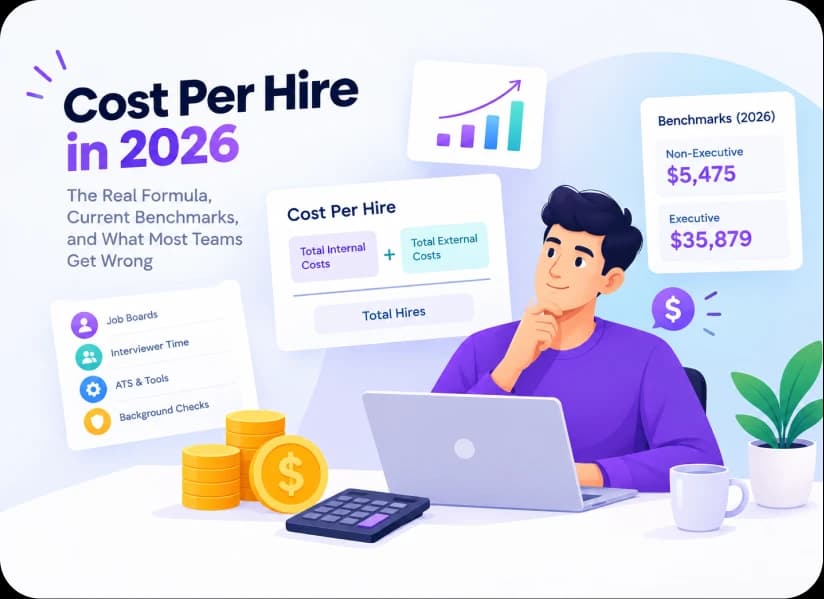
Incorporating AI in hiring processes offers cost-saving benefits for organizations by reducing time-to-fill job openings and automating routine tasks, thereby decreasing labor expenses. Moreover, enhanced speed and accuracy in hiring lower the cost per hire and mitigate the risk of the cost of bad hire, when candidates are hired correctly, they are likely to stay longer, positively affecting the organization's bottom line.
Improve the quality of hire
AI recruiting can enhance the quality of hires through standardized job matching. By examining a candidate's skills, experience, and other attributes, AI can align them with the most appropriate job openings, ensuring that candidates are matched accurately with suitable roles.
This allows recruiters to engage in diverse conversations tailored to candidates' personalities and professional skills, which ultimately leads to higher-quality hires and a recruitment process focused on human interaction.
Data-Driven Decision Making
AI can analyze a candidate's past performance and assess their potential success within a specific role. By considering a candidate's skills, experience, and other relevant data, AI recruitment can predict their future performance, helping companies make more informed hiring decisions.
Enhancing talent Acquisition with Getgeek
Now that you've grasped the fundamentals of leveraging AI in recruitment, it's time to discover the ideal recruiting tool for your needs.
At Getgeek, we recognize the potential of AI in recruitment. Our AI-driven talent acquisition platform empowers organizations to attract, engage, and onboard top talent with greater efficiency and effectiveness.
By optimizing the recruitment journey, Getgeek accelerates the process, enhancing speed, efficiency, and efficacy for businesses. With a target of reducing time-to-hire to under 24 hours, it slashes costs and efforts by an impressive 47%.
What are some risks of adopting AI in recruitment?
While AI in recruitment can bring efficiency benefits, it also presents risks that organizations need to manage cautiously. These include avoiding the reinforcement of bias and ensuring not to overly rely on technology, which might result in mismatches between job requirements and candidate capabilities.
Here are some challenges to consider before integrating AI in recruitment processes:
Bias in Algorithms
One of the main risks associated with AI recruitment is the potential for bias in algorithms. AI algorithm works on data and is trained if the data is biased, whether conscious or unconscious (such as favoring certain educational backgrounds or age groups), ultimately AI will provide better results.
This poses a considerable challenge for organizations aiming to leverage AI to enhance diversity, equity, and inclusion in their recruitment processes. It is imperative for organizations to ensure that their AI algorithms are trained on diverse datasets to minimize bias and promote fairness in hiring.
Data Security Concerns
Integrating AI in hiring process raises privacy and legal concerns due to the collection and analysis of candidate data. The risk of mishandling sensitive information and potential data breaches exists, with legal issues arising from non-compliance with regulations such as GDPR or CCPA, which impose strict rules on data collection and storage.
Chance of mismatch candidates
AI recruitment tools are designed to align candidates with job descriptions using predetermined criteria, potentially overlooking the subtleties of a role or company culture. This creates a risk where AI may favor candidates who excel on paper but may not be the optimal fit in real-world scenarios. This leads to hiring individuals strong in technical competencies but lacking in essential soft skills or cultural alignment.
Steps for using AI in recruitment
Incorporating AI into recruitment processes presents a revolutionary approach to talent acquisition for organizations. This concise guide aims to furnish recruiters with a practical and actionable roadmap for seamlessly integrating AI into their recruitment strategies.
Step 1: Initial Assessment and Planning
Before delving into AI implementation, it's essential to evaluate your existing recruitment processes and pinpoint specific areas where AI can make substantial enhancements.
Assess Current Processes: Identify inefficiencies and time-consuming aspects in your recruitment workflow.
Establish AI Goals: Clearly define objectives for AI integration, such as streamlining screening processes or elevating candidate quality.
Choose Appropriate AI Solutions: Select appropriate AI recruitment tools that match your objectives, such as an AI-driven Applicant Tracking System for automating resume screening or AI video interview platform to conduct virtual interviews.
Step 2: Implementation and Integration
Having established clear objectives and selected suitable tools, the subsequent phase involves the implementation and integration of AI into your current recruitment practices.
Implement AI recruitment Tools: Deploy AI tools for tasks such as candidate sourcing and screening.
Train Your Team: Educate your recruitment team on the effective use of these AI tools.
Integrate AI into Existing Workflow: Ensure a smooth incorporation of AI tools into your current recruitment processes.
Step 3: Addressing Practical Challenges
Integrating AI presents challenges that must be addressed proactively to ensure successful implementation.
Mitigate Bias: Implement regular audits of AI algorithms to identify and address potential biases, ensuring a fair and inclusive hiring process.
Human-AI Synergy: Leverage AI's strengths for streamlining tasks, while maintaining the human element for crucial aspects like candidate assessment and relationship building.
Data Security First: Prioritize data security and compliance by adhering to relevant regulations throughout the AI-powered recruitment process.
Step 4: Optimization and Monitoring
The last stage emphasizes continuous monitoring and optimization of AI tools to ensure they remain aligned with your recruitment goals and adaptable to evolving needs.
Fine-Tuning the Process: Continuously evaluate how well AI tools are achieving your recruitment goals, making adjustments as needed.
Feedback Loop: Gather insights from both internal users (recruiters) and candidates to refine your AI strategy and ensure a positive experience for all.
Evolving with AI: Regularly update your AI recruitment tools and strategies to stay aligned with industry trends and address changing organizational needs.
Conclusion
As AI continues to advance, we anticipate the emergence of even more innovative AI recruiting tools in the future. These tools will further streamline and automate recruitment processes, resulting in enhanced efficiency and effectiveness.
In summary, AI recruitment represents a transformative development in the recruitment industry. By automating administrative tasks and standardizing job matching, organizations can decrease time-to-hire, elevate the quality of hires, and improve the candidate experience.
At Getgeek, we're equipped to assist organizations in overcoming these challenges and optimizing their recruitment processes with AI.

Get Weekly AI Recruitment Insights Delivered to Your Inbox
Join 5,000+ forward-thinking recruiters who rely on our expert analysis of AI in recruiting automation trends, case studies, and actionable strategies to stay competitive in the evolving talent market.
Ready to Transform Your Hiring Process?
Still have questions about our AI recruiting software? Get personalized answers and see our recruiting automation software in action with a free demo.
You wouldn't have read this far if you believed there could be no improvements in your hiring process
Every day without the right people costs thousands in lost revenue. Go ahead, take Getgeek for a test drive - it's completely free and we promise we don't bite.

Automate your company's hiring pipeline and deploy custom end-to-end AI solutions that deliver proven candidate matching.
Help
Customer SupportPlatforms
Getgeek Job BoardSubscribe to newsletter
Join our community
.webp) Join our Slack community
Join our Slack communityCall Us
(+92) 323-0295713
Email Us
contact@getgeek.ai